Lisa's Blog

I'd Rather Be Writing

Memories of a Dunkin Donut with a Handle

I was asking a co-worker, a millennial, if she had ever seen the original Dunkin donut.

My father would take me to Dunkin Donuts when I was a child. He got me this special donut with a handle. I’d hold the handle and actually dunk the donut into my drink. Can’t remember what the drink was, but I remember these donuts with a handle.

Does anyone else remember the Dunkin Donut that had a handle on it?

Flower Delivery

Flowers from Work

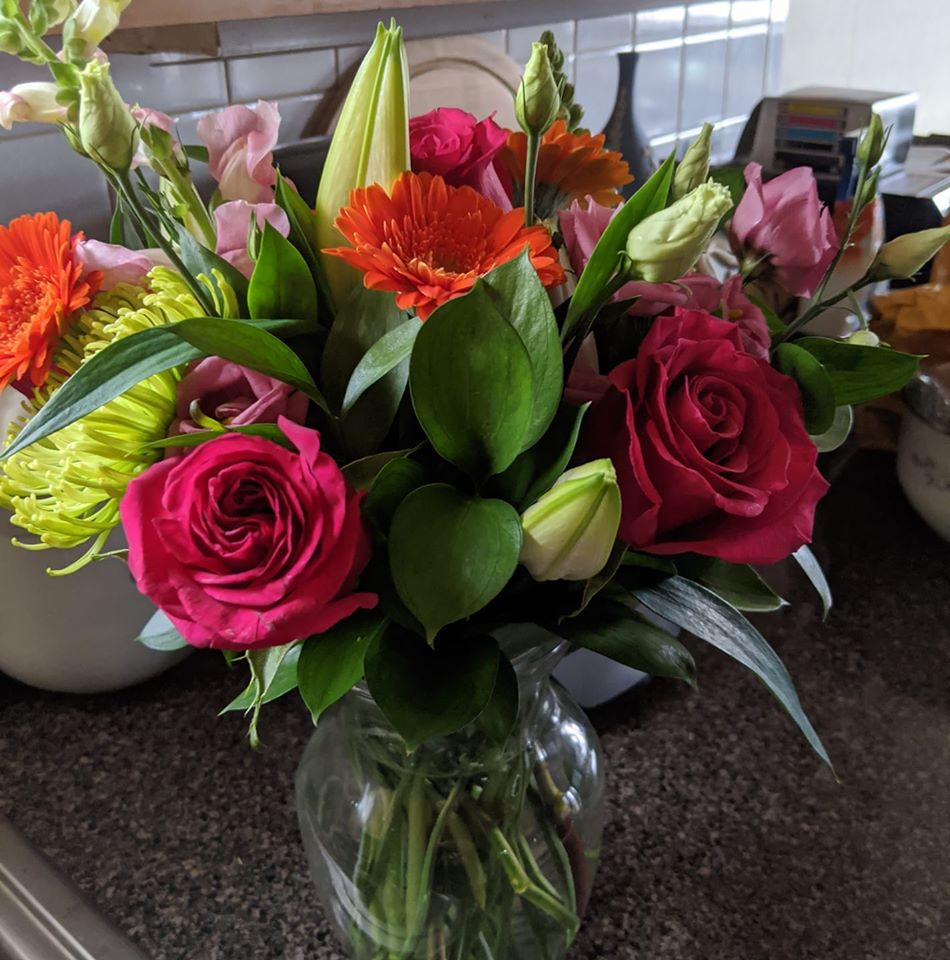
A few years ago, I received a nice surprise from work. There was a knock at the door. It was a delivery man with a large vase of flowers for me.

I had taken leave for medical reasons. I broke my leg and was out of work.

The English Major


What’s your major?

English

What can you do with that?

Everything

What I’m Reading: How to Read a Novel by John Sutherland

“Is there a wrong way to read a novel?” Two different people asked me this last week while I was carrying around John Sutherland’s How to Read a Novel. Even though the author doesn’t exactly write about a correct way to read, he does give some ideas about how to approach a novel. To grasp and understand the meaning of a piece, we don’t only need to look at what the author writes, but we need to look at what the author doesn’t write.

We can have a deeper understanding of the author’s points when we consider the time period, lifestyle, or inventions at that time. It also helps to place the author with other famous people, or imagine who was president at the time. Was there a war or other catastrophe the author just experienced. By looking at what the author does not write about, we can see his intentions more clearly.

Sutherland states that without a sense of the time period, we cannot grasp the full meaning of what the author was trying to say. Sutherland writes, 

“Framing fiction within the necessary time and culture setting is tricky and requires practice. But without that framework, something will be seriously missing.” 

A perfect example is Virginia Woolf’s Mrs. DallowayWe know it was first published in 1925. Of course, she had the idea and began writing maybe a few years earlier. We can only imagine England recovering from the loss of millions of lives during the Great War of 1914-1918 and the Spanish Flu pandemic. 

Why is this important?

Southerland points out that the film version of Mrs. Dalloway, released in 1997, had a romanticized, misleading cover that doesn’t remain true to the original story.

“The film version of Mrs. Dalloway (1997) inspired a tie-in paperback whose romanticized cover is as remote from Spanish Flu and the Great War, as it is from Mars.” 

John Sutherland’s book has some dull moments, but in all he reinforces theories from any college literature class: look at the time period. There’s no wrong way to read a novel, just a better way.

The Selfie

Here is a list of Oxford Dictionary’s new words. Every year, they add about 1000 new words to their database. This year, selfie was one of them.

College students today (or Millennials) will know right away what this is, but for all my fellow Gen Xers out there, let me fill you in.

A selfie is a picture taken of one’s self. The person holds their camera or phone out as far as they can and shoots down at their face.

(If you try this at home, hold the camera above your face. Just TRUST me on this.)

Then the person uploads it to a social media site. It’s a great way to remember doing something fun either alone or together in a group. You have probably seen them on the internet and didn’t even know it.

Millennials have been doing this for years.
So what’s the big deal?

Words in the dictionary feel more serious. They are more permanent. Now that selfie is added to the dictionary, it is forever engrained in our canon of literary words and this gives it more credibility. They are legitimate (which means, “ability to be defended with logic or justification” according to oxforddictionary.com.)

A dictionary is also a reliable source. (It’s not from a wiki.)

I have to admit, though, oxforddictionaries.com is not my first choice to look up trendy new words.

The first place I go is urbandictionary.com. The definitions are more casual, sometimes funny. They define selfie as “a picture taken of yourself that is planned to be uploaded to Facebook.” Then they add the funny, urban legend part: “If a person has to take a picture of themselves, then they have no friends.” Now, that part isn’t true. A person might just be alone or maybe three or four of them want to be in the picture together. The purpose is to remember this moment in time.

I know what the Baby Boomers are thinking: urbandictionary.com isn’t a reliable source. That’s okay. I may check the urbandictionary.com or a wiki (No, I didn’t write that) to guide me in the right direction.

So, we have some homework to do, Gen Xers and Baby Boomers. We need to keep learning new words or we just might regret it some day.

ENL 200 The Short Story

Today is the last day of my summer class. Reading 100 short stories in four weeks was challenging, but also enlightening. For those of us familiar with Sir Arthur Conon Doyle’s work, it was fascinating to come across the works of Edgar Allen Poe. The parallels are infinite. If there were only one or two similarities in theme, then this argument would not be valid. But, “The Study in Scarlet” feeds off of many elements of “The Murder in the Rue Morgue.” Therefore it is obvious that Poe has had an influence on Doyle’s work.

It was challenging, but well worth the effort. Edgar Allan Poe’s “The Murders in the Rue Morgue”  was published in 1841. It was in this story that Poe developed his plot. For the first time, Poe used a master detective to discuss his cases with a loyal admirer.

Sir Arthur Conan Doyle was not the creator of this concept, and he wasn’t the first author to invent the detective mystery. Doyle’s A Study in Scarlet was published until 1887, 46 years after Poe’s detective stories. Each literary period influences the next. This is evident when contrasting Poe’s and Doyle’s detective stories.

The summer reading list consisted of many stories I’ve read before:

But some stories I read for the first time:


The hero in each, Monsieur C. Auguste Dupin and Sherlock Holmes, have some admiral qualities that make them stand out from the rest of the world. Each possesses an exceptionally mind which is articulate, intelligent, and even arrogant. Although, as readers, we can forgive this overconfident nature because the stories are so compelling, they satisfy our need for intrigue. The narrator in Poe’s story admires Dupin’s intelligence, “At such times, I could not help remarking and admiring (although from his rich ideality I had been prepared to expect it) a peculiar analytic ability in Dupin.” Doyle alludes to a similar admiration in Holmes, “Yet his zeal for certain studies was remarkable, and within eccentric limits his knowledge was so extraordinarily ample and minute that his observations have fairly astounded me.” Both narrators give details and analysis to arouse our curiosity and then deliver a clever ending to both satisfy and entertain us.

A second similarity is that the stories are retold by an eye witness. Both Dr. Watson and the narrator of “The Murder in the Rue Morgue” are friends (of the hero), retelling an interesting story about how the mystery is solved. Poe tells the reader that this is a story about the narrator meeting Dupin, “Our first meeting was at a library in the Rue Montmarte … “ Although Doyle’s “A Study in Scarlet” does not go in to the depths of the murder they are about to solve, Watson relates how he was introduced to Holmes by a mutual friend. Stamford says that he knows someone who is looking for a roommate, “A fellow … was bemoaning himself this morning because he could not get someone to go halves with him in some nice rooms which he found … “ Both are distinct in their own voices, yet similar ideas can be seen.

If it were just these two incidents, one could say it was a coincidence, but there are many similarities. In both narratives, the police have exhausted all their methods of deduction and are forced to go to the hero for assistance in solving the murders. The Purloined Letter has many similarities to A Scandal in Bohemia. Instead of solving a murder, the hero is looking for an item (Dupin a letter, Holmes a photo.) What is shocking is that they both use a distraction (one, a man in the street, the other I believe starts a fire) to gain the information they need.

Growing up with Sherlock Holmes, it was an enlightenment to see the resemblances in each author’s styles and ideas of what makes a good detective story.

Casa Loma, Toronto

Castle1On July 6, 2013 we explored Casa Loma during a quick visit to Toronto. Built in 1911, it is a representation of an English castle of the 1800s. Several movies and commercials have filmed at this location. Movies include The Vow and X-Men. Commercials include Honey Nut Cheerios and M&M’s. Can you name any other movies?

Here’s a look inside Casa Loma. I’m looking down from a balcony wondering why the pipe organ is not under (or next to) the pipes. Then I talk about the chandeliers. If this represents a castle, there was no electricity. So, how did they light the candles? Anyway, many people visiting today. It’s like a Museum, lots to see.

Library Rantings

Working at the library is different every day. If it’s the first week of a new semester, there are lots of questions from incoming freshman and transfer students. In the summer, it’s a little more casual. We usually shift books from one section to another and organize.

In the summer of 2013, I worked with another student at the library. We were both English majors, but he was a year ahead of me. I liked to ask him about the professors. Some he admired. Some he hated, but he always had funny stories about his experiences.

This particular morning I brought in my 10-minute play I wrote for Professor Nee’s playwriting class. The Diagnosis was my first work of fiction. Based on a true story, it was something I had thought about for a long time. The story was just waiting to be told and here was an opportunity to dramatise the narrative. I was happy with the results.

He said he liked it, then asked if I wanted to see something he wrote for class. Well, I read his personal essay and actually cried.

It was actually a piece of his soul, put on paper, for everyone to see.

It was about the death of his brother. describing the feelings and how he deals with it even today. Well, it moved me like nothing else I’ve read. It wasn’t just words on a paper. It was his heart’s blood, smeared for all of us to see.

That’s the writing I want to create.

For me English isn’t just about writing and reading great classical literature. It’s about creatively thinking and communicating with other people. That’s why I’m studying English at UMass Dartmouth.

Well, he graduated last year. Now, I’m looking ahead to my senior year, but until then it’s back to shifting books.

Summer Vacation